100% Factory Direct: 3 Generations of Horticultural Lighting Manufacturing Excellence
From 2100 μmol/s HPS to digital LEDs, NUMBER explores the 3 eras of lighting innovation redefining ROI for large-scale CEA.
100% Factory Direct: 3 Generations of Horticultural Lighting Manufacturing Excellence
As a leading OEM/ODM manufacturing hub, NUMBER has witnessed the technological shift in Controlled Environment Agriculture (CEA) firsthand. From high-intensity discharge systems to the latest semiconductor-based solutions, our production lines have consistently set the benchmark for industrial-grade durability and photon efficiency.
Understanding the manufacturing evolution of Fluorescent, HID (HPS), and LED systems is critical for commercial operators seeking to secure their supply chain and maximize long-term ROI.
1. Legacy Heavy-Duty Production: High-Pressure Sodium (HPS)
For decades, our HPS assembly lines have produced the "heavyweight champions" of greenhouse supplemental lighting. Designed for high-bay environments, these fixtures are engineered to withstand the rigorous demands of large-scale glasshouse operations.
- Engineering Edge: Our standard 1000W fixtures are calibrated to deliver a consistent 2100 μmol/s output with high-penetration spectral curves optimized for tall-canopy crops like tomatoes and cucumbers.
- Manufacturing Insight: While HPS remains a powerhouse for deep penetration, its thermal output requires high-clearance mounting. For facilities with vertical constraints, semiconductor solutions are now more viable.
2. Precision Components: Fluorescent Horticultural Grow Lights
Historically, our fluorescent production focused on the tissue culture and nursery sectors. These units provide the gentle, diffused light required for early-stage propagation where uniform distribution is paramount.
- Manufacturing Edge: Low CAPEX and high-uniformity ballast designs protect fragile tissues from light stress.
- Market Shift: Due to higher energy consumption and faster light decay (lumen maintenance issues), we are actively transitioning these production lines toward nursery-specific LED modular bars.
3. The Semiconductor Frontier: LED Grow Lights
The modern era of cultivation is defined by the LED—a semiconductor-based technology that allows for surgical manufacturing precision. At our facility, we don't just "build" lights; we engineer spectral recipes.
- Spectral Engineering: We utilize high-binning chips to hit precise peaks at Deep Blue (450nm) and Hyper Red (660nm), eliminating energy waste on non-essential wavelengths.
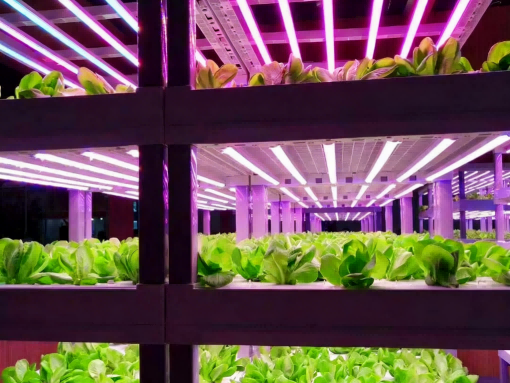
- Industrial Advantage: Unlike thermal sources, our LED modules are "cool" light sources, enabling multi-layer stacking for vertical farms and increasing yield per square foot.
- Quantifiable Gains: Data from our testing bays confirms that upgrading to high-efficiency LED systems can boost crop output by up to 60% while reducing HVAC loads by 50%.
Hybrid Solutions & The Next Generation
Advanced facilities are increasingly requesting Hybrid Lighting Architectures. By integrating our deep-penetrating HPS fixtures with LED precision, growers can manage metabolic heat in cold climates while reducing overall energy consumption by 15-20%. Looking forward, our R&D department is already prototyping Laser Diode (LD) integrations, targeting a further 20% leap in photosynthetic efficiency.
Conclusion: Secure Your Supply Chain with NUMBER
The transition to LED-driven modular systems is no longer a trend—it is an industrial necessity. In an era of fluctuating energy costs, the ability to control every photon through precision manufacturing is your ultimate competitive advantage.