How to Check Grow Light Beam Angle Before Layout Approval
A greenhouse LED layout checklist for verifying beam angle, PPFD maps, mounting height, and Number toplight specifications before purchase approval.
Beam angle is a layout input, not a yield promise. Before a greenhouse team approves a commercial LED toplight order, it should confirm how the fixture spreads photons at the planned mounting height, how adjacent fixtures overlap, and whether the submitted PPFD map matches the crop zone being designed.
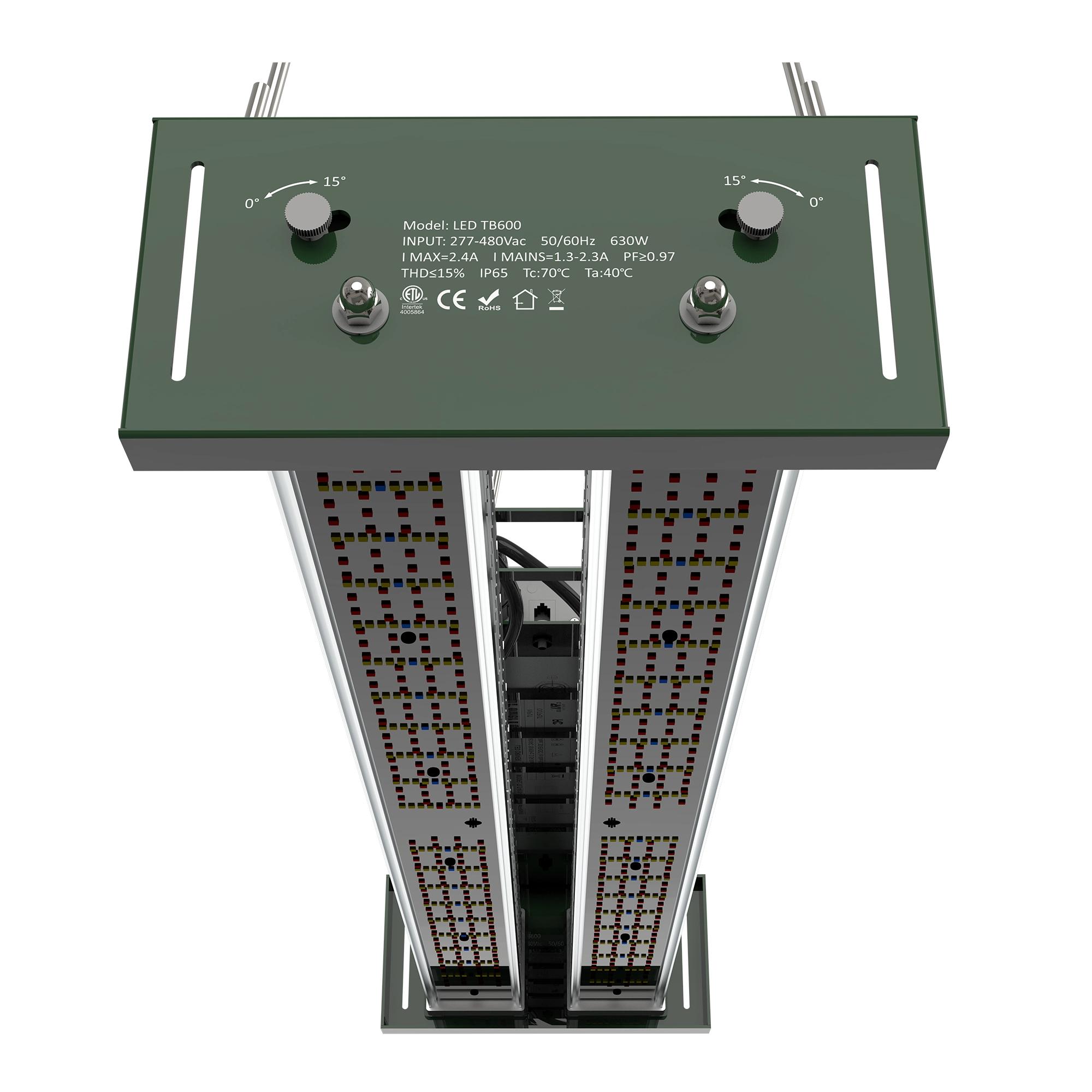
For Number greenhouse toplights, start with verified model data. The LED TB600 Sanity product record retrieved on August 12, 2026 lists 600W±5% power consumption, 2100 μmol/s PPF, 3.5 μmol/J efficacy, 0-10V dimming, AC 200-480V input, and a 150° beam angle. The LED TB830 Sanity product record retrieved on the same date lists 830W±5% power consumption, 2910 μmol/s PPF, 3.5 μmol/J efficacy, 0-10V dimming, and an adjustable wide beam feature up to 150°.
The Buying Question
Ask this before layout approval: does the fixture beam angle support the intended crop area at the actual mounting height, with documented PPFD distribution rather than only a center-point intensity claim?
A wide beam can help spread supplemental light over a larger greenhouse bay, but it still needs layout evidence. Mounting height, truss spacing, crop height, aisle width, greenhouse structure, fixture tilt, glass transmission, and sunlight contribution all change the final PPFD distribution at canopy level.
What to Verify in the Submittal
- Model identity: match the quotation, datasheet, Sanity product page, and layout file to the same fixture model and wattage. Do not approve a TB600 layout using a generic 600W LED photometric file.
- Beam-angle evidence: record whether the beam angle is a fixed specification or an adjustable project feature. For TB600, the current product specification lists 150°. For TB830, the current product feature text says the wide beam is adjustable up to 150°.
- Mounting height: require the PPFD map or simulation to state the distance from fixture to crop canopy. A map at one height should not be reused for a different crop height without recalculation.
- Grid coverage: check center, edge, corner, and overlap zones. A single peak PPFD number cannot show whether the crop receives usable uniform coverage.
- Electrical and control fit: confirm input voltage, dimming method, and controller plan at the same time. Beam-angle approval is not useful if the fixture cannot be wired or dimmed in the planned zone.
How to Use the Number TB600 and TB830 Data
Use TB600 when the project needs a verified 600W greenhouse toplight record with 2100 μmol/s PPF, 3.5 μmol/J efficacy, AC 200-480V input, 0-10V dimming, and a listed 150° beam angle. Use TB830 when the greenhouse layout needs a higher-output 830W toplight record with 2910 μmol/s PPF, 3.5 μmol/J efficacy, 0-10V dimming, and the adjustable wide-beam design note.
Those values are fixture specifications. They do not prove crop yield, energy savings, rebate eligibility, or uniformity in a specific greenhouse. The approval package still needs a project layout, crop target, mounting height, and PPFD distribution map.
Evidence Standard for Approval
University of Missouri Extension advises buyers to check PPFD distribution maps or measure PPFD with a quantum sensor at the desired height, and to avoid grow lights without spectrum and PPF or PPFD information. DLC horticultural technical requirements also show that optical data such as beam angle, field angle, and mounting position can be part of formal product reporting for applicable replacement-lamp categories.
Source links: University of Missouri Extension grow-light guide; DLC horticultural technical requirements.
Approval Checklist
- The exact model ID, wattage, PPF, efficacy, input voltage, dimming method, and beam-angle statement are copied from the current product record or datasheet.
- The PPFD map names the mounting height, crop plane, grid size, fixture spacing, room or greenhouse dimensions, and assumptions about reflectance or sunlight contribution.
- The layout reviewer checks overlap zones and perimeter zones, not only the highest center value.
- Any claimed certification, rebate eligibility, yield result, or energy saving is removed unless it is supported by a current authoritative listing or documented project evidence.
Next Step
Before approving a greenhouse toplight purchase, send the crop target, mounting height, bay dimensions, and control-zone plan with the selected Number model. The useful output is a model-specific submittal package: verified fixture specifications plus a layout map that shows how the chosen beam angle performs in the actual project geometry.