How to Check Grow Light Dimming Compatibility Before Ordering
A commercial procurement checklist for matching fixture dimming methods, controller channels, connectors, and documents before ordering grow lights.
Dimming compatibility should be checked before a commercial grow-light order is approved, especially when the project mixes fixtures, rooms, controllers, or private-label variants. A fixture that lists 0-10 V dimming still needs a matching controller output, connector plan, channel map, wiring document, and commissioning check. This is a procurement and integration checklist, not a claim about yield, savings, certification status, or crop response.
1. Record the fixture-side dimming method by model
Current Sanity product data lists the LED TB600 greenhouse toplight with 0-10 V dimming, AC 200-480 V input voltage, 600 W power consumption, 2100 micromoles per second PPF, 3.5 micromoles per joule PPE, 150 degree beam angle, passive thermal management, and a power factor of at least 0.97. The LED JT720F record lists knob and 0-10 V dimming, AC 220-240 V input voltage, 720 W power, 1950 micromoles per second PPF, 2.7 micromoles per joule efficacy, passive cooling, and a 1 year standard warranty. Treat those as model-specific fields; do not assume another wattage, spectrum, driver, or OEM version has the same dimming behavior without its own datasheet or Sanity record.
2. Match controller outputs to the fixture groups
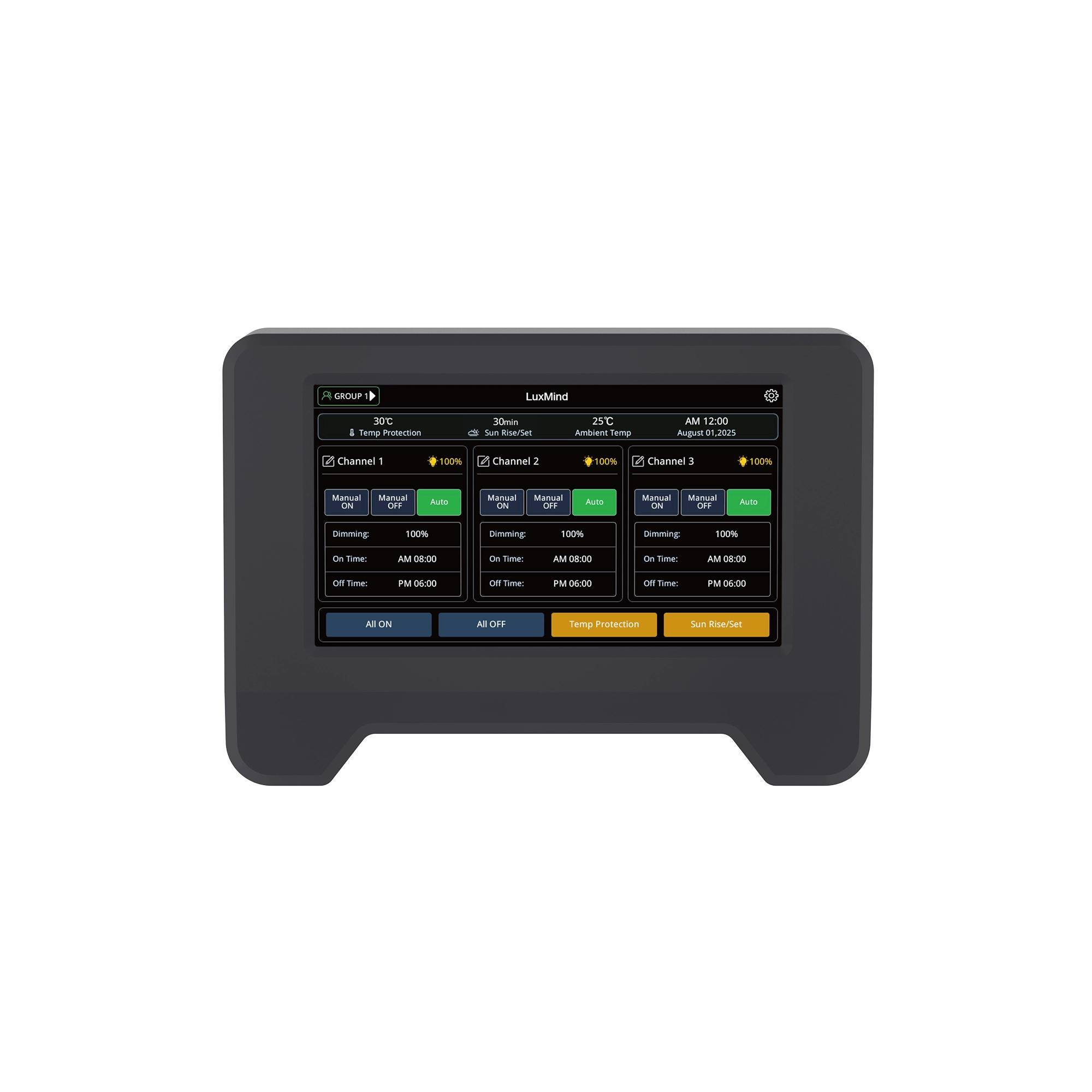
For controller-side evidence, the current LuxMind 3CH Controller record lists 12 V input voltage and a control output of two groups of 0-10 V dimming, each with one RJ11 plus one RJ45 for 3-channel dimming. It also lists IP54 and a 20000 h average lifespan. Before ordering, turn that into a room schedule: zone name, fixture model, number of fixtures, channel purpose, connector type, cable route, sensor requirement, and the person responsible for commissioning the dimming response.
3. Ask for the documents that prove the match
The DesignLights Consortium horticultural technical requirements are useful context because they discuss product-level controllability, reporting of dimming and control methods, connector or transmission hardware, integral control capabilities, and wiring diagrams for certain dimmable products. For a Number project, the practical takeaway is to request a model-specific specification sheet, controller specification, wiring diagram, channel schedule, and acceptance test before a mixed fixture order is released.
4. Use a five-line dimming compatibility checklist
Before issuing the purchase order, the buyer, installer, and supplier should be able to answer these five questions in writing:
- Which exact fixture model and driver version is being ordered, and what dimming method is listed for that model?
- Which controller output, channel, and connector will control each fixture group?
- Does the wiring diagram show the same 0-10 V, RJ11, RJ45, sensor, or adapter arrangement that the site will install?
- What dimming response will be checked during commissioning, such as off, minimum output, 50 percent, full output, and scheduled ramp behavior?
- Who signs off if a private-label change, replacement driver, longer cable, or different controller is substituted before shipment?
5. Define the OEM change-control trigger
For OEM or private-label orders, dimming compatibility should be treated as a controlled specification, not a casual accessory choice. Spectrum, power, size, logo, cable length, dimming, and mounting are customizable fields on the TB600 record, while the JT720F record lists spectrum, logo, and color as customizable fields. If the project changes any driver, cable, connector, controller, or enclosure detail, refresh the compatibility sheet before approving the sample or mass-production order.
Source note: Product-specific statements were checked against current Sanity records for LED TB600, LED JT720F, and LuxMind 3CH Controller on 2026-08-11. General controllability context was checked against the DesignLights Consortium horticultural technical requirements page and V3.0 technical requirements PDF retrieved on 2026-08-11.