How to Choose Between 3-Channel and 5-Channel Grow Light Controllers
A procurement checklist for deciding when a commercial grow room needs 3-channel or 5-channel 0-10V grow light control.
A 3-channel or 5-channel grow light controller should not be chosen because the larger number sounds more advanced. It should be chosen because the crop trial, fixture wiring, spectrum plan, and operating team actually need that number of independently documented dimming channels. For commercial buyers, the safest specification is a channel map first and a controller model second.
1. Start with the channel map
Write down every lighting output that must be controlled separately: white or broad-spectrum intensity, red, blue, far-red, UV if present, separate rooms, and any sensor-linked behavior. Oklahoma State University Extension notes that LEDs can be adjusted for specific plant responses and that blue, red, and far-red wavelengths are used differently in plant production. That does not mean every room needs five channels. It means the buyer should specify which channels have a real crop, research, or operating purpose before ordering hardware.
2. Use 3-channel control when the recipe is defined and stable
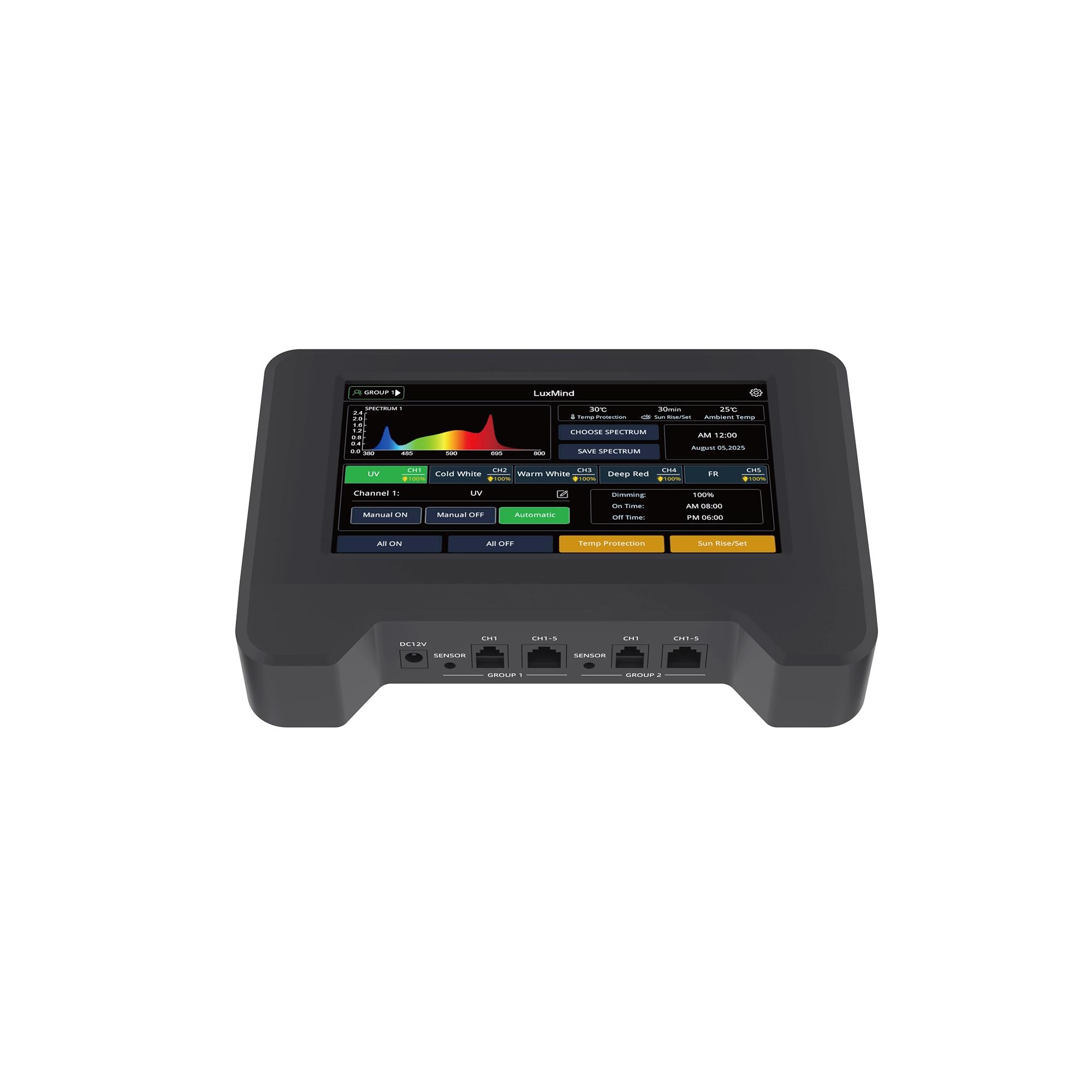
The Number LuxMind 3CH Controller is listed in the current Sanity product record as a 20 W controller with 12 V input, IP54 rating, and an average lifespan of 20000H. Its control-output specification lists two groups of 0-10V dimming with one RJ11 and one RJ45 for 3-channel dimming, plus an optional temperature sensor per group. That makes it a practical candidate when the lighting recipe can be represented by three dimming channels and the project does not need to preserve extra channels for future trials.
3. Consider 5-channel control when the buyer must protect experiment flexibility
The Number LuxMind 5CH Controller is also listed as a 20 W, 12 V controller with IP54 rating and 20000H average lifespan. Its product record lists two groups of 0-10V dimming and describes the RJ45 configuration as supporting a 5-channel dimming option with an optional temperature sensor per group. Use that extra channel capacity only when the buyer can name the additional outputs that will be controlled, measured, and documented.
4. Compare submittals, not just model names
Ask the supplier to submit the controller model, channel assignment table, fixture compatibility list, cable and connector plan, sensor plan, commissioning procedure, and replacement part references. DesignLights Consortium horticultural technical requirements provide product-level reporting and controllability context, but a product page alone does not prove that a room-specific wiring plan is complete. The submittal should show how each channel is named, where it terminates, what range it controls, and who signs off the final settings.
5. Avoid unsupported performance assumptions
Do not convert a controller channel count into a yield claim, energy-saving claim, or crop-quality guarantee. A controller can make a lighting plan easier to repeat, but it does not replace PPFD mapping, spectral verification, crop records, or environmental controls. If a buyer wants to test a new spectrum, define the baseline recipe, trial duration, measurement method, crop stage, and acceptance criteria before treating the controller as the reason for any result.
6. Procurement checklist
Before selecting 3CH or 5CH control, confirm the fixture dimming protocol, exact channel count, channel names, RJ11/RJ45 connector plan, number of fixture groups, sensor requirement, mounting location, operating temperature range, IP rating requirement, access permissions, and documentation format. Also confirm whether the project needs spare channel capacity for future cultivar, photoperiod, or spectrum trials.
Turn the channel map into a project brief
A useful controller brief includes the room layout, fixture list, channel map, crop schedule, required sensor inputs, commissioning responsibility, and acceptance test. Number can review those details through an OEM/ODM project discussion before the controller is fixed in the purchasing specification.
Sources and verification
Product-specific statements in this article were checked against current Sanity product records for the LuxMind 3CH Controller and LuxMind 5CH Controller on 2026-08-03. General spectrum-control context was checked against Oklahoma State University Extension HLA-6450 and the DesignLights Consortium horticultural lighting technical requirements page. Certification names are repeated only as Sanity product-record fields; buyers should request current certificate documents before using them in compliance decisions.