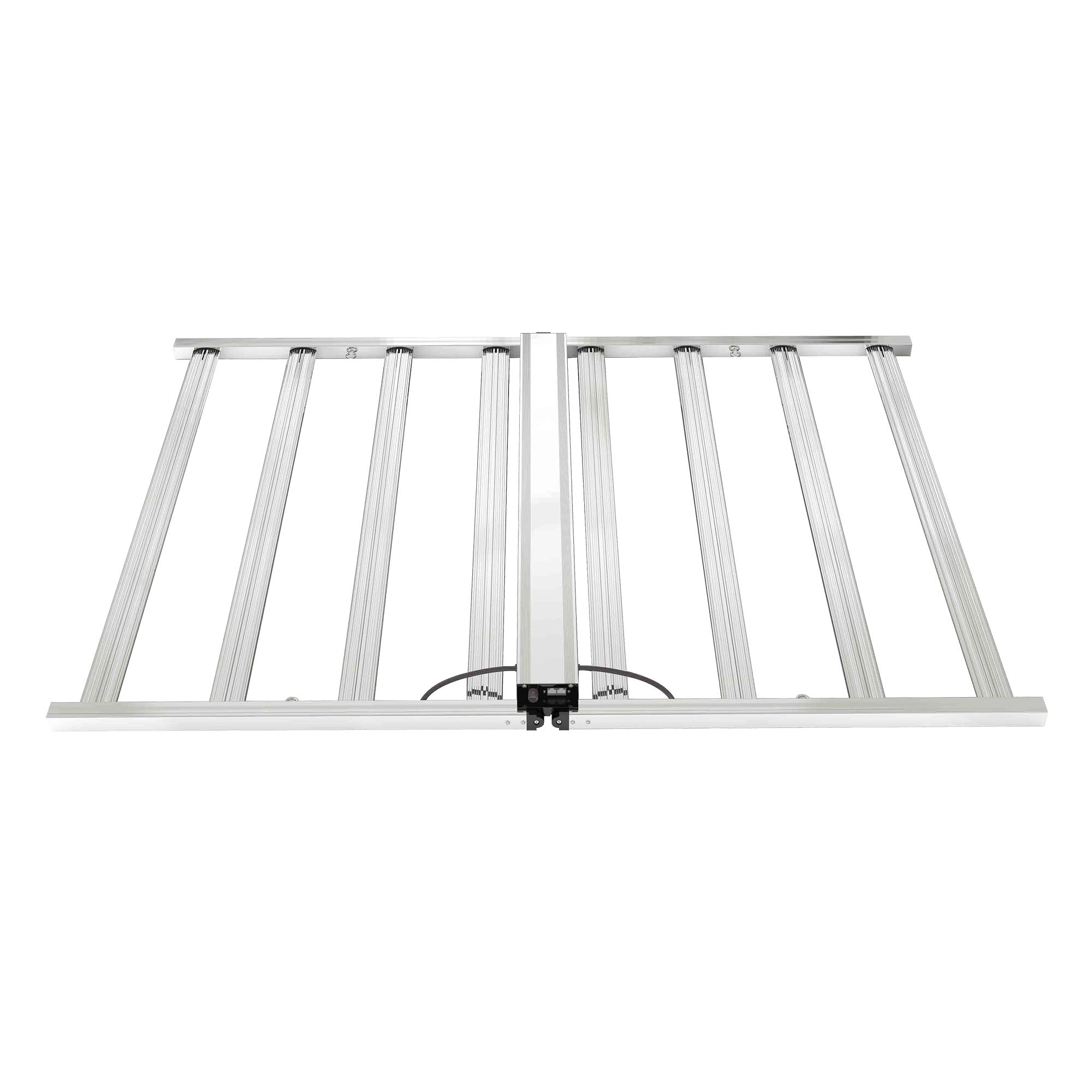
How to Choose Between 720W and 830W LED Grow Lights
A B2B checklist for choosing 720W or 830W indoor LED grow lights using verified Number specs, PPFD/DLI planning, electrical load, HVAC, and controls.
Short answer: choose the fixture after the room team has confirmed target PPFD/DLI, mounting height, fixture count, circuit capacity, heat load, and control zoning. A higher wattage fixture can reduce fixture count in some layouts, but it can also concentrate power, heat, and service requirements. The right comparison is not wattage alone; it is delivered photons, layout uniformity, electrical fit, and how easily the room can dim or stage light over the crop cycle.
This article compares two current Number indoor LED options as a specification example: the LED SR720 Pro and the LED DT830. The first-party product data cited below was checked in Sanity on 2026-07-30. Treat these as fixture specifications, not crop-yield, energy-savings, rebate, or compliance guarantees.
Verified fixture data used for this comparison
Current Sanity product data lists the SR720 Pro as a 720 W indoor LED grow light with 720 W +/-5% power consumption, PPF values recorded as 1750 umol/s and 1670 umol/s, 2.7 umol/J efficacy, passive thermal management, 0-10 V dimming, an operating temperature range of -20°C to 35°C, and 12.8 kg weight. Because the PPF field contains two values, ask the supplier to identify the spectrum, input condition, or version attached to each value before using it in a final lighting plan.
Current Sanity product data lists the DT830 as an 830 W indoor LED grow light with 830 W +/-5% power consumption, 2330 umol/s PPF, 2.8 umol/J efficacy, passive thermal management, 0-10 V dimming, an operating temperature range of -20°C to 35°C, and 13.5 kg weight.
The product records include certification fields, but this article does not use those fields as a compliance claim. For a North American or EU procurement file, request the current certificate, test report, model number match, and listing status before representing a fixture as certified for a project.
Start with the crop target, not the wattage
Virginia Tech Extension explains DLI as the total photosynthetic light received by the crop over a day, combining light intensity and photoperiod. In constant-light planning, DLI can be estimated from PPFD and lighting hours. That means a room design needs a target average PPFD, photoperiod, and uniformity expectation before the buyer can decide whether 720 W or 830 W fixtures are appropriate.
In practice, ask for a layout showing mounting height, canopy dimensions, aisle losses, reflector or wall assumptions, target average PPFD, minimum PPFD, and max-to-min uniformity. Published PPF tells you how many photons leave the fixture; it does not prove how many photons reach every canopy point in your room.
Use a five-part decision checklist
1. Photon requirement
If the target room needs fewer fixtures and the electrical service can support the load, the DT830 offers the higher published photon output in the current data set: 2330 umol/s. If the room needs finer placement, lower connected load per fixture, or more zoning flexibility, the SR720 Pro may be easier to distribute. The deciding document should be a room-level PPFD map, not a catalog wattage table.
2. Electrical service and breaker planning
Compare total connected load, not a single fixture. For example, a room using 40 fixtures would connect about 28.8 kW at 720 W nominal and about 33.2 kW at 830 W nominal before any driver tolerance, control gear, or code-required derating is considered. Have the electrical engineer confirm voltage, branch circuits, receptacles or hardwiring, control wiring, and local code requirements.
3. Heat and HVAC coordination
Almost all electrical input power becomes room heat. Moving from 720 W to 830 W increases nominal heat per fixture, even if efficacy is higher. Before choosing the larger fixture, ask whether HVAC, dehumidification, airflow, and fixture spacing can manage the added load without creating hot zones or leaf-temperature problems.
4. Control zones and dimming behavior
Both verified product records list 0-10 V dimming. The project team should still define how many fixtures belong in each zone, whether zones follow benches or crop stages, where sensors are mounted, and what happens after a controller or signal failure. Dimming compatibility should be tested with the intended controller before production rollout.
5. Procurement evidence
Before placing a volume order, request a current datasheet, IES or equivalent photometric file where available, wiring diagram, packaging data, certificate copies if compliance is required, and a sample-approval checklist. DesignLights Consortium horticultural requirements are a useful reference for the kinds of product-level reporting buyers should expect, even when a specific fixture purchase is not being made through a utility program.
When the 830 W fixture is the better starting point
- The room has enough electrical and HVAC capacity for the higher fixture load.
- The lighting plan benefits from fewer fixtures with higher published PPF per fixture.
- Mounting height and optics can still deliver the required PPFD uniformity.
- The buyer can validate dimming and control behavior during a sample test.
For those conditions, review the LED DT830 product page and ask for a project-specific PPFD layout before locking the fixture count.
When the 720 W fixture is the better starting point
- The room has tighter electrical limits or needs lower connected load per fixture.
- Fixture placement flexibility matters more than maximum output per unit.
- The project needs spectrum/channel clarification before committing to the higher-output fixture family.
- The grower wants a sample phase focused on zoning, dimming, and crop-stage recipes.
For those conditions, review the LED SR720 Pro product page and ask the sales engineer to clarify which PPF value applies to the intended spectrum or configuration.
Minimum evidence to request before ordering
A defensible purchase file should include the chosen model, spectrum or version, fixture quantity, layout file, target PPFD and photoperiod, connected load, control-zone schedule, mounting plan, sample test criteria, and document list. If the room requires private label, cable changes, spectrum changes, or packaging requirements, start that discussion through Number’s OEM/ODM customization page before the sample is built.
Bottom line
Choose 830 W when the room can use higher fixture output without compromising electrical capacity, heat control, or uniformity. Choose 720 W when placement flexibility, lower load per fixture, or channel/spectrum clarification is more important. In both cases, the buying decision should be tied to a layout and sample test, not a generic wattage preference.