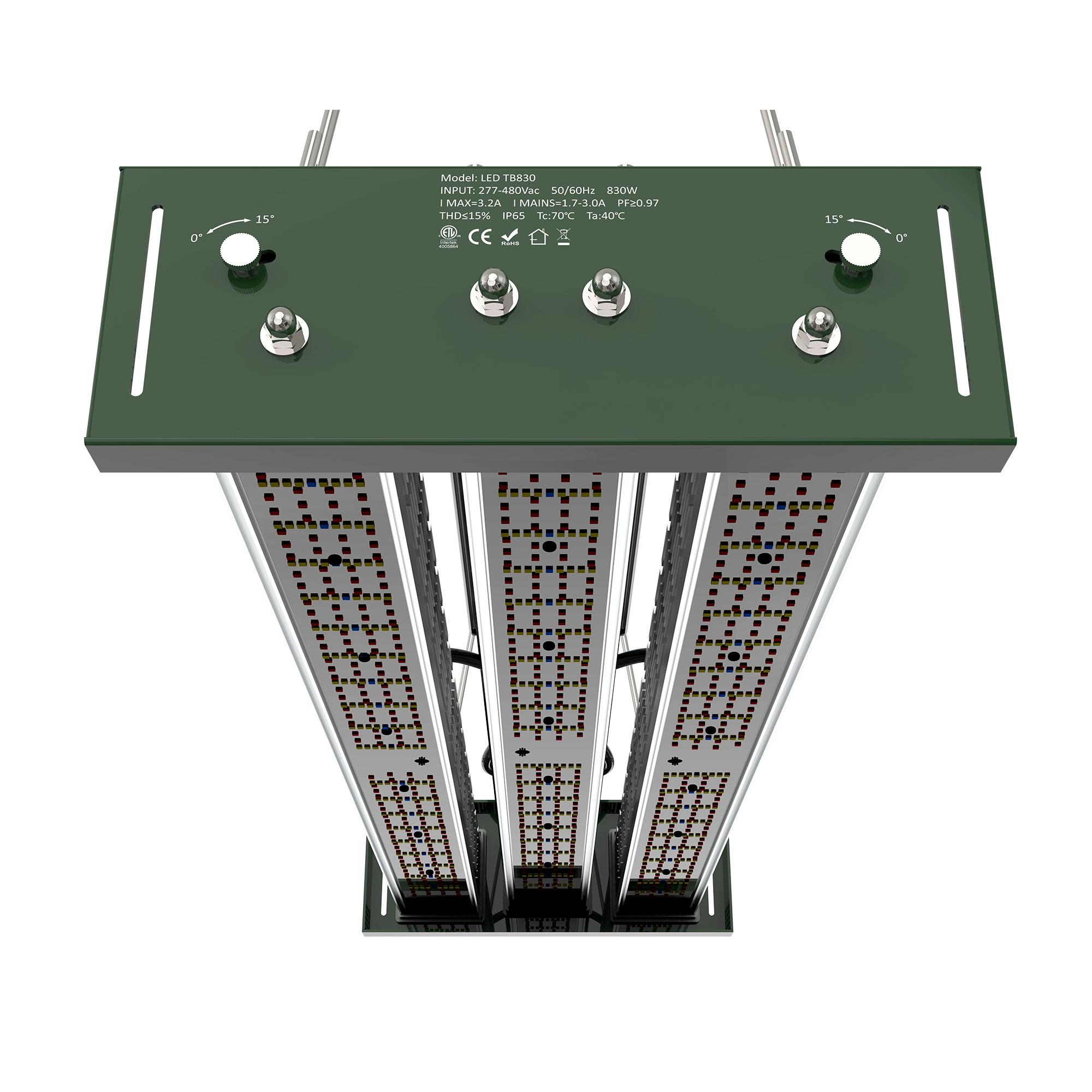
How to Choose Between TB600 and TB830 Greenhouse Toplights
A greenhouse toplight selection checklist for choosing between Number TB600 and TB830 rows before layout, quotation, and approval.
A greenhouse toplight choice should start with the crop-light target, mounting geometry, and electrical plan, not with the highest wattage available. For Number greenhouse projects, the practical question is when to quote the TB600 row and when the higher-output TB830 row is the better starting point for layout review.
1. Define the missing light before choosing the model
Record the crop, crop stage, target canopy PPFD, photoperiod, seasonal daylight contribution, mounting height, trellis or screen shadows, and control-zone plan. University of Missouri Extension describes PPF as fixture photon output and DLI as the daily total of photosynthetic light at the crop. That distinction matters: TB600 versus TB830 is a fixture-output decision, while final crop light still depends on spacing, height, daylight, dimming, and measurement at canopy level.
2. Compare verified output, power, and weight side by side
Current Sanity data lists the Number LED TB600 greenhouse toplight at 600 W +/-5 percent, 2100 micromoles per second PPF, 3.5 micromoles per joule efficacy, and 7.0 kg weight. The Number LED TB830 greenhouse toplight is listed at 830 W +/-5 percent, 2910 micromoles per second PPF, 3.5 micromoles per joule efficacy, and 11.2 kg weight. Use those values as the approved product rows; do not turn them into crop-output, utility-cost, or financial-return claims without project-specific evidence.
3. Use TB600 when the design needs lower load per fixture
The TB600 row is usually the cleaner starting point when the project needs a lower fixture wattage, lighter suspended load, narrower circuit allocation, or more granular dimming zones. Its verified data includes AC 200-480 V input voltage, 0-10 V dimming, passive thermal management, -20 C to 35 C operating temperature, 150 degree beam angle, and a five-year standard warranty. Ask for the layout file to prove whether the lower-output row can still meet the target PPFD and uniformity in the actual greenhouse bay.
4. Use TB830 when fixture count or output density drives the quote
The TB830 row is the better candidate when the same greenhouse zone needs higher verified fixture output and the structure, circuits, controls, and mounting plan can accept the higher wattage and weight. Current fields list 0-10 V dimming, passive thermal management, -20 C to 35 C operating temperature, and a five-year standard warranty. The buyer should still request a bay-specific layout and electrical review before converting that higher PPF into fixture count or procurement quantities.
5. Keep customization and certification fields separate
Current Sanity rows list both TB600 and TB830 as customizable for spectrum, power, size, logo, color, cable length, dimming, and mounting. They also list DLC, CE, and RoHS as certification fields. Treat these as first-party product fields only until the exact model, label, declaration, or certificate file is assigned to the order. A customized spectrum, cable length, or mounting kit should be reviewed as a configured product row, not assumed from the base model.
6. Ask for the evidence packet before approving the quote
Before a purchase order or OEM greenhouse toplight project is released, request one comparison sheet covering model ID, PPF, power tolerance, efficacy, input voltage, dimming method, weight, operating range, warranty term, customization rows, certificate file owner, layout file owner, and approval date. The smallest reliable decision is not TB600 or TB830 in isolation; it is the verified model row plus the layout and electrical evidence that show why that row fits the greenhouse zone.