How to Evaluate Under-Canopy LED Grow Lights Before a Pilot
A practical under-canopy LED grow light pilot checklist for commercial indoor growers: measure lower-canopy PPFD, verify fixture specs, plan controls, and document results.
Under-canopy LED lighting is a pilot decision before it is a rollout decision. The commercial question is not whether lower-canopy light can matter in theory; it is whether a specific fixture, crop architecture, bench layout, and operating plan justify the added hardware, wiring, cleaning, and controls work in your room.
Short answer
Evaluate under-canopy fixtures by measuring the lower-canopy light gap, choosing a fixture with verified PPF, power, dimming, beam, and environmental specifications, then running a controlled pilot zone against a comparable reference zone. Do not buy from a yield claim alone unless the supplier can show the crop, cultivar, trial method, dates, and measurement data behind it.
1. Confirm that the lower canopy is actually light-limited
Start with a PPFD map, not a product quote. Measure the top canopy and representative lower-canopy positions at the same growth stage and fixture settings. University of Missouri Extension guidance on grow lights defines PPFD as the instantaneous photon density at the plant surface and DLI as the accumulated photon dose over the day, so a useful pilot brief should record both the measured PPFD pattern and the photoperiod used to calculate DLI.
2. Define the pilot zone before selecting quantity
Pick one representative room section or bench run where plant density, irrigation, air movement, cultivar, and harvest timing can be kept comparable to a reference zone. Record aisle access, spray and sanitation routines, trellis height, worker clearance, cable paths, and whether lights need to be removed between cycles. Under-canopy hardware that interferes with labor can fail commercially even when the light output is technically adequate.
3. Verify fixture output, power, and form factor
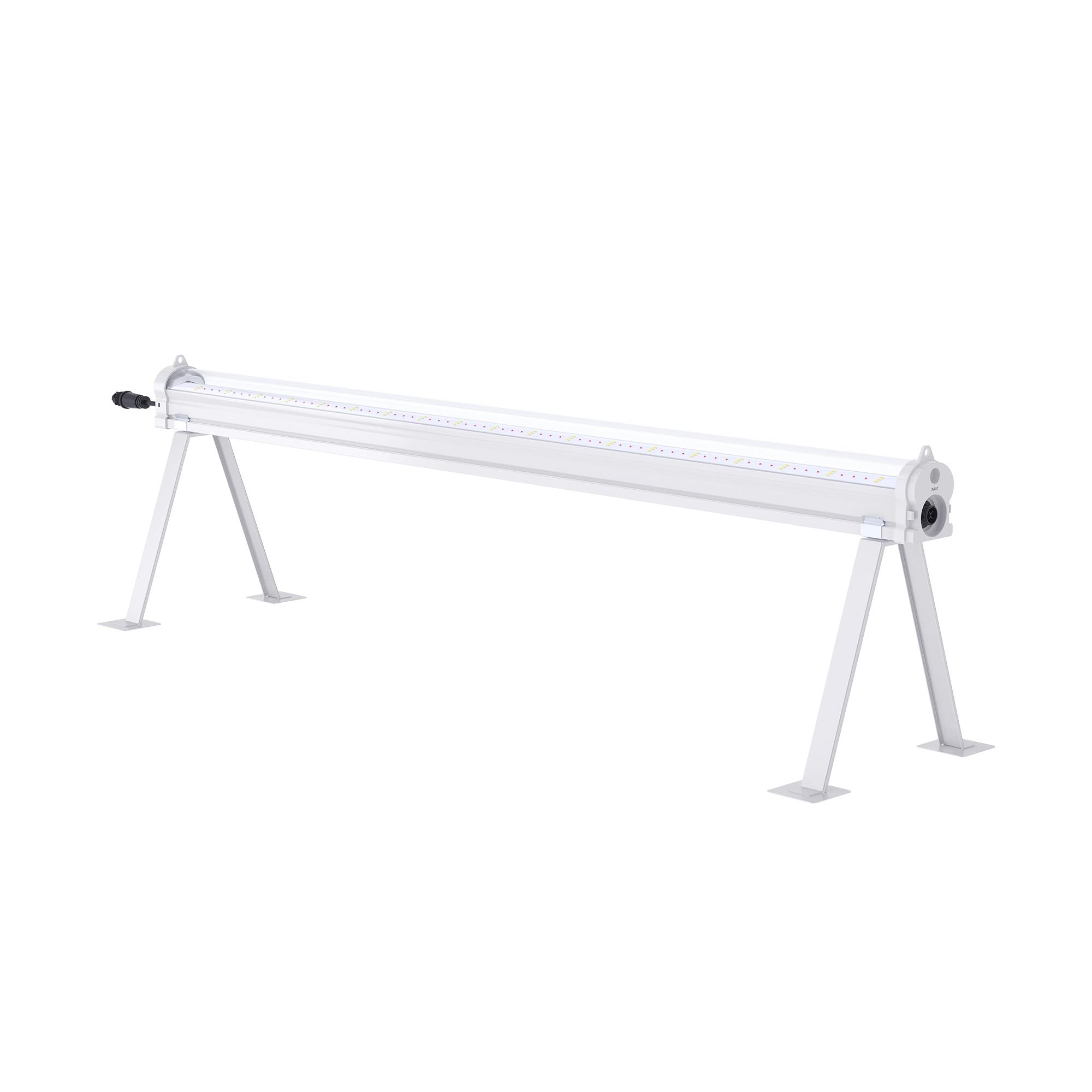
For a concrete specification check, the Number LEDex-F120 under-canopy grow light Sanity product record lists 120 W +/-5% power consumption, 336 umol/s PPF, 2.8 umol/J efficacy, passive thermal management, 0-10 V dimming, and 2.2 kg weight. It also lists IP65 water resistance, a 150 degree beam, compatibility with 4 ft / 2 ft rack configurations, and daisy-chaining up to 20 units. DLC horticultural technical requirements are a useful reference for why fixture-level PPF, input power, efficacy, and dimming data should be documented clearly. Treat Number values as fixture specifications for project screening, not as a crop-result guarantee.
4. Check electrical load, dimming, and daisy-chain limits
A pilot should document the number of fixtures per run, branch-circuit loading, inrush assumptions from the driver supplier, connector exposure, voltage drop, and the dimming method used by the room controller. If the under-canopy lights are dimmed separately from toplights, label that as a separate control zone so changes to lower-canopy light can be evaluated independently.
5. Measure crop response without overstating causality
A peer-reviewed study on supplemental lighting from underneath a canopy supports the underlying biological reason to test lower-canopy light: shaded leaves can receive less usable light than upper leaves. That does not prove a commercial result for every crop or room. For a buyer-grade pilot, record the baseline and trial-zone PPFD maps, photoperiod, DLI estimate, temperature and humidity observations, irrigation changes, labor notes, harvest quality grading, and any rejected data points.
6. Ask for evidence before scaling
Before a multi-room order, request the current product datasheet, electrical and installation instructions, certification files needed for your market, warranty terms, and any test report that supports the exact claim being used in the purchase case. If a supplier claims yield, energy savings, or crop-quality improvement, ask for the trial design and measurement method before including that number in ROI calculations.
Turn the pilot into a purchase brief
For an OEM or project conversation, bring the room dimensions, bench or row spacing, lower-canopy PPFD measurements, target photoperiod, controller type, cleaning constraints, and desired mounting method. Number can then review whether the LEDex-F120 specification fits the pilot or whether a customized power, cable, logo, or mounting configuration should be discussed through the OEM/ODM project page.