How to Specify LED Greenhouse Toplights for an HPS Retrofit
A practical specification checklist for commercial greenhouse teams replacing HPS fixtures with LED toplights, from crop targets and layout to controls and pilot validation.
Replacing HPS fixtures with LED toplights is not a one-for-one wattage swap. A reliable retrofit begins with the crop-light target and ends with a measured pilot. This checklist helps commercial greenhouse teams turn that process into a fixture specification and an installation plan.
1. Define the crop-light target before choosing fixture power
Record the crop, growth stage, desired canopy PPFD, photoperiod, seasonal daylight contribution, and target daily light integral. Do not start with the question, 'How many watts replace my existing lamp?' Those crop and site inputs determine fixture spacing, mounting height, dimming range, and the number of fixtures required.
2. Compare fixtures with PPF and efficacy, not wattage alone
Fixture power describes electrical input. Photosynthetic photon flux (PPF) describes the photon output available from the fixture, while efficacy relates that output to power draw. Both are needed to compare alternatives honestly and to estimate the electrical load of a design.
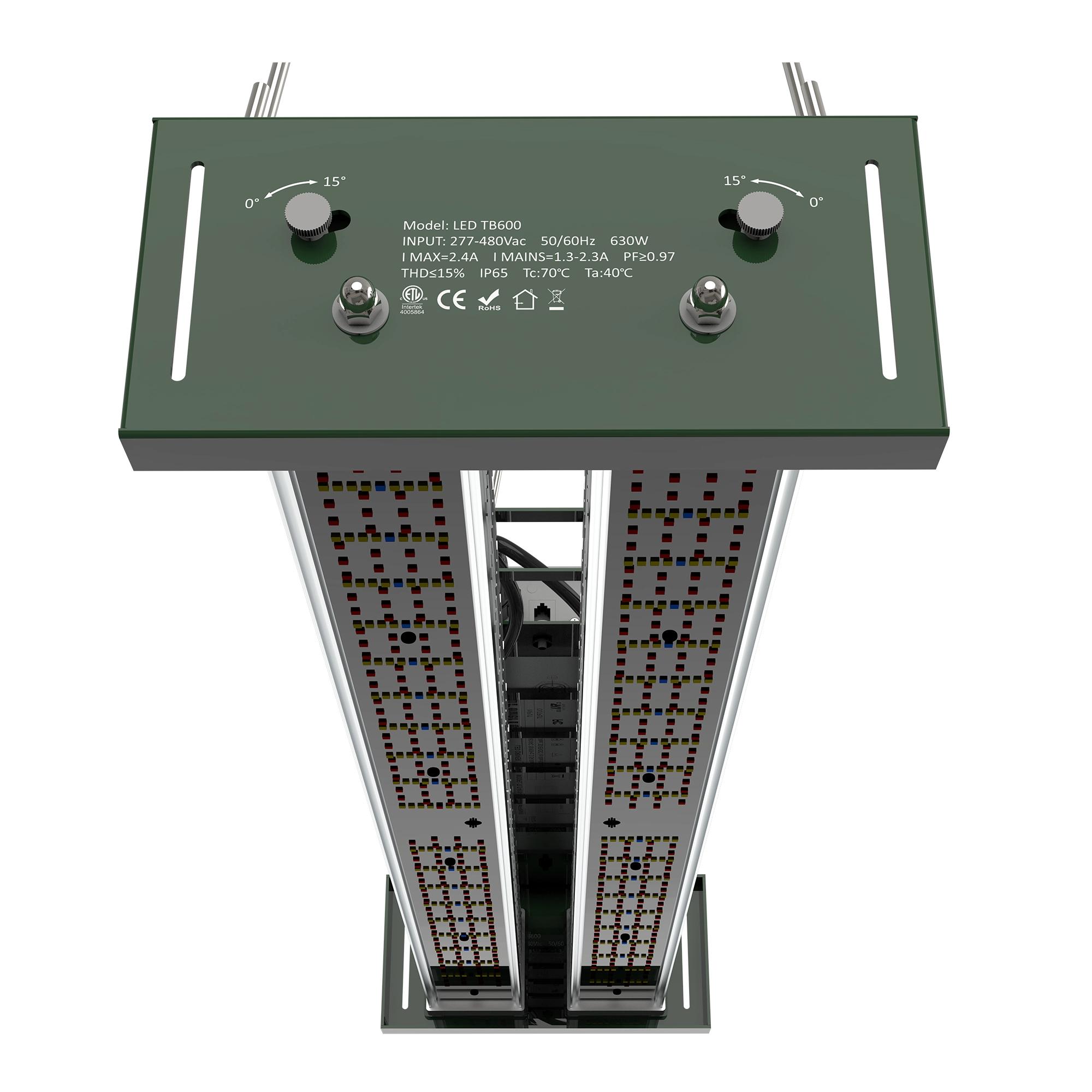
For example, the Number LED TB600 greenhouse toplight is specified at 600 W, 2,100 μmol/s PPF, and 3.5 μmol/J efficacy. The published values are fixture specifications, not a promise of crop yield; final results depend on layout, crop management, and the greenhouse environment.
3. Design for distribution and uniformity before maximizing peak output
A layout should be based on a PPFD grid at canopy height, not a single center-point reading. Evaluate fixture spacing, mounting height, beam angle, trellis shadows, roof geometry, and edge rows. In a greenhouse, a wider beam can reduce gaps between fixtures, but only a layout calculation and on-site measurement can confirm uniformity for a particular crop zone.
4. Check electrical and control compatibility early
Confirm input voltage, circuit capacity, dimming protocol, control zones, cable routing, and mounting before the purchase order is finalized. The TB600 specification lists AC 200–480 V input and 0–10 V dimming, which can be useful for staged commissioning and seasonal light management. Your electrician and controls team should still validate compatibility with the specific greenhouse installation.
5. Validate one representative zone before full deployment
Install a pilot in a representative bay, then measure PPFD at multiple canopy points, verify dimming response, observe heat and humidity behavior, and compare crop performance under the same operating plan. A pilot exposes layout and workflow issues while they are still inexpensive to correct.
Selecting a Number greenhouse toplight
For greenhouse projects requiring a higher-output option, the Number LED TB830 toplight is specified at 830 W, 2,910 μmol/s PPF, and 3.5 μmol/J efficacy. Review the full product pages for specifications, customization options, and available documentation before using either model in a design.
Turn the checklist into a project brief
Bring the crop target, canopy dimensions, mounting constraints, existing electrical details, and control requirements to the first engineering discussion. That gives the project team the information needed to recommend a suitable configuration and validate it with a layout plan.