How to Specify Foldable LED Grow Lights for Indoor Rooms
A procurement checklist for foldable indoor LED grow lights, covering verified JT720F specs, layout, electrical service, controls, and sample approval.
Short answer: specify a foldable indoor LED grow light by checking the crop-light target, open fixture dimensions, mounted weight, electrical service, dimming interface, ingress rating, warranty, and the evidence behind PPF and PPE. A foldable frame can make handling easier, but it does not replace a fixture schedule, PPFD map, mounting check, or pilot measurement.
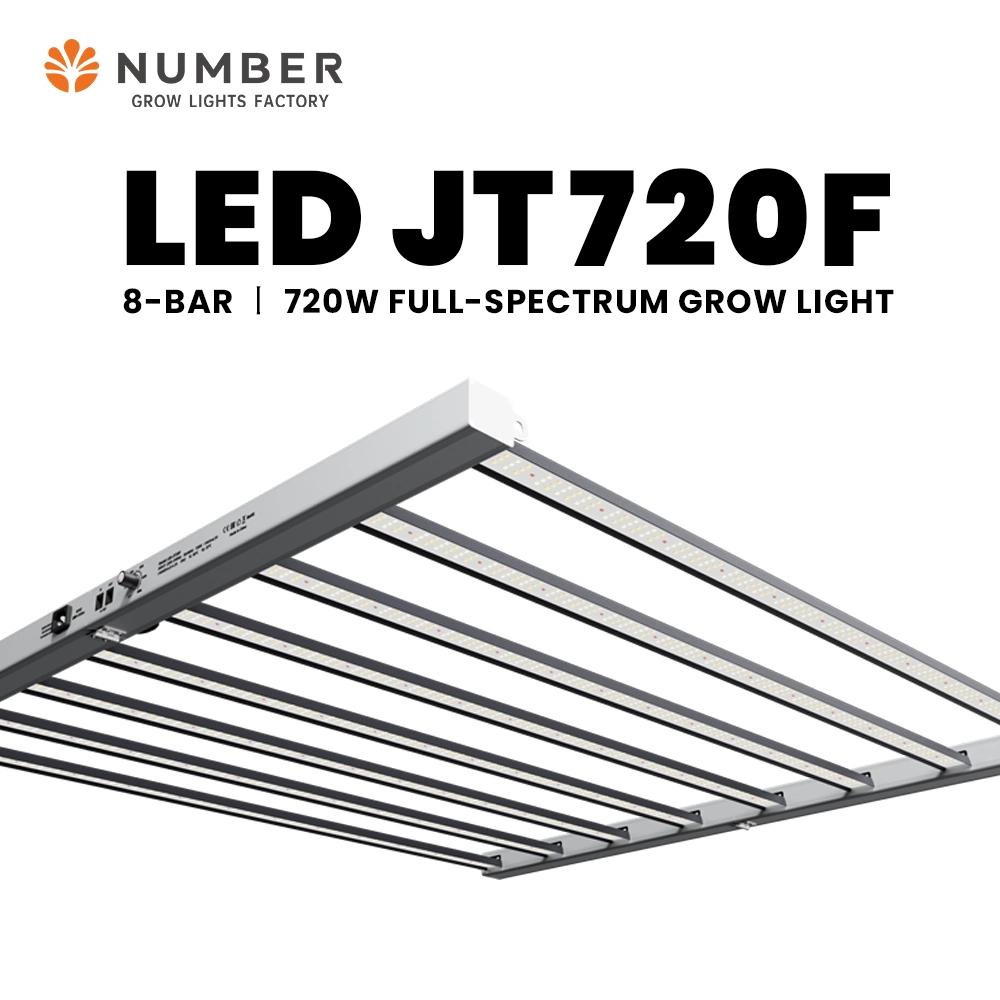
For Number buyers evaluating the LED JT720F foldable 720 W grow light, the verified scope is specific: the current Sanity product record and attached JT720F datasheet list 720 W input power, 1950 umol/s PPF, 2.7 umol/J PPE at 240 V AC, AC 220-240 V input, manual knob plus 0-10 V dimming, passive cooling, IP65 rating, FCC/CE/RoHS certificates, 8.2 kg product weight, 1050 x 1111 x 46 mm product dimensions, and a one-year standard warranty.
Evidence Scope
This article uses first-party JT720F Sanity data retrieved on July 29, 2026 and the attached JT720F datasheet as the source for model-specific claims. General lighting-method context comes from University Extension guidance that treats PPFD and DLI as operating measurements, and from DLC horticultural technical requirements that treat PPF, PPE, wattage, intended use, and controllability as reported fixture attributes for LED horticultural products. It does not claim a yield increase, energy saving, certification beyond the listed certificates, customer result, or competitor comparison.
1. Start With the Crop-Light Target, Not the Fold
The first decision is the required canopy light, not the fixture shape. Define target PPFD at the crop plane, photoperiod, and DLI for the crop and growth stage. PPF tells you how much photosynthetic light leaves the fixture each second; PPFD and DLI tell you what the crop receives over area and time. A 1950 umol/s fixture still needs layout work before it becomes a reliable canopy plan.
Ask for a layout or pilot plan that states mounting height, fixture spacing, aisle assumptions, edge losses, dimming setting, and measurement grid. Treat the grower’s existing bench or room dimensions as part of the specification, because a fixture that fits one room may create poor overlap or service access in another.
2. Confirm Open Dimensions and Installed Weight
A foldable fixture should be checked in two states: how it ships or stores, and how it occupies the room after installation. The verified JT720F product dimensions are 1050 x 1111 x 46 mm, and the verified product weight is 8.2 kg. Those numbers are enough to start a mounting and handling review, but they do not answer carton size, pallet count, or folded-dimension questions by themselves.
For procurement, request the packed dimensions, gross weight, pallet quantity, and any minimum bend or hinge-handling instructions before confirming container plans or stockroom assumptions. For installation, confirm the mounting hardware, cable exit direction, service clearance, and whether workers can unfold and hang the fixture safely within the available aisle width.
3. Match Electrical Service Before Quantity
The JT720F datasheet lists AC 220-240 V input, 720 W input power at 240 V AC, and a power factor of at least 0.97. Before a buyer multiplies fixture count by room count, the electrical review should confirm branch-circuit loading, driver inrush guidance, regional plug or wiring requirements, and whether controls wiring is separated from mains wiring.
Do not use fixture wattage alone as the procurement rule. A lighting schedule should include voltage, nominal current, control wiring, maximum fixtures per circuit as approved by the electrical designer, and how the grower will operate dimming during startup, crop changes, cleaning, and maintenance.
4. Verify Controls and Operating Behavior
The verified JT720F control fields are manual knob dimming and 0-10 V dimming; the datasheet also describes universal dimming compatibility. For a B2B order, translate that into a controls checklist: confirm the controller signal type, channel count, dimming curve expectations, default state after power loss, and whether the room needs manual override during commissioning.
If the fixture will be part of a larger private-label or project-specific system, document the desired controller, cable length, label language, spectrum option, packaging requirements, and acceptance sample before production. Number’s OEM/ODM project discussion page is the right next step when the fixture spec needs private-label, spectrum, color, logo, or integration decisions beyond the standard product page.
5. Separate Product Ratings From Crop Claims
The JT720F record supports product-level statements: 720 W power, 1950 umol/s PPF, 2.7 umol/J PPE, IP65 rating, passive cooling, FCC/CE/RoHS certificates, and one-year standard warranty. It does not, by itself, prove a grower’s yield, energy cost, crop quality, payback period, or room-level uniformity. Those outcomes depend on layout, crop, environment, controls, operation, and measurement.
A good supplier conversation keeps those categories separate. Use datasheet values to shortlist the fixture. Use a layout simulation or measured pilot to test PPFD uniformity and DLI delivery. Use site electrical data to estimate power demand. Use production samples to approve fit, label, packaging, and dimming behavior.
Buyer Checklist
Before issuing a purchase order, ask for these items in writing:
1. Product identity: exact model name, revision, spectrum option, and datasheet version.
2. Optical data: PPF, PPE, spectrum, beam angle, and the test condition behind each value.
3. Room plan: mounting height, spacing, PPFD map, dimming setting, and target DLI calculation.
4. Mechanical fit: open dimensions, folded or packed dimensions, weight, mounting kit, and service clearance.
5. Electrical fit: input voltage, current, power factor, circuit assumptions, and regional wiring requirements.
6. Controls: knob, 0-10 V, PWM or other interface details, plus controller compatibility evidence.
7. Environment: IP rating, operating temperature range, humidity range, cleaning expectations, and passive-cooling clearance.
8. Commercial evidence: warranty, certificates, sample process, packaging, private-label requirements, and change-control plan.
When the JT720F Is a Fit
The JT720F is commercially relevant when the buyer wants a 720 W full-spectrum indoor fixture, an 8-bar format, verified 1950 umol/s PPF, 2.7 umol/J PPE, 220-240 V electrical service, manual plus 0-10 V dimming, IP65 rating, and customization options for spectrum, logo, and color. It should not be selected only because it folds; it should be selected when the verified fixture data matches the room design and the supplier can document the project-specific details that are not shown in the standard product record.
Next action: review the JT720F product specification, then request a layout or sample review with the actual room dimensions, target crop, mounting height, voltage, controller plan, and packaging requirements.