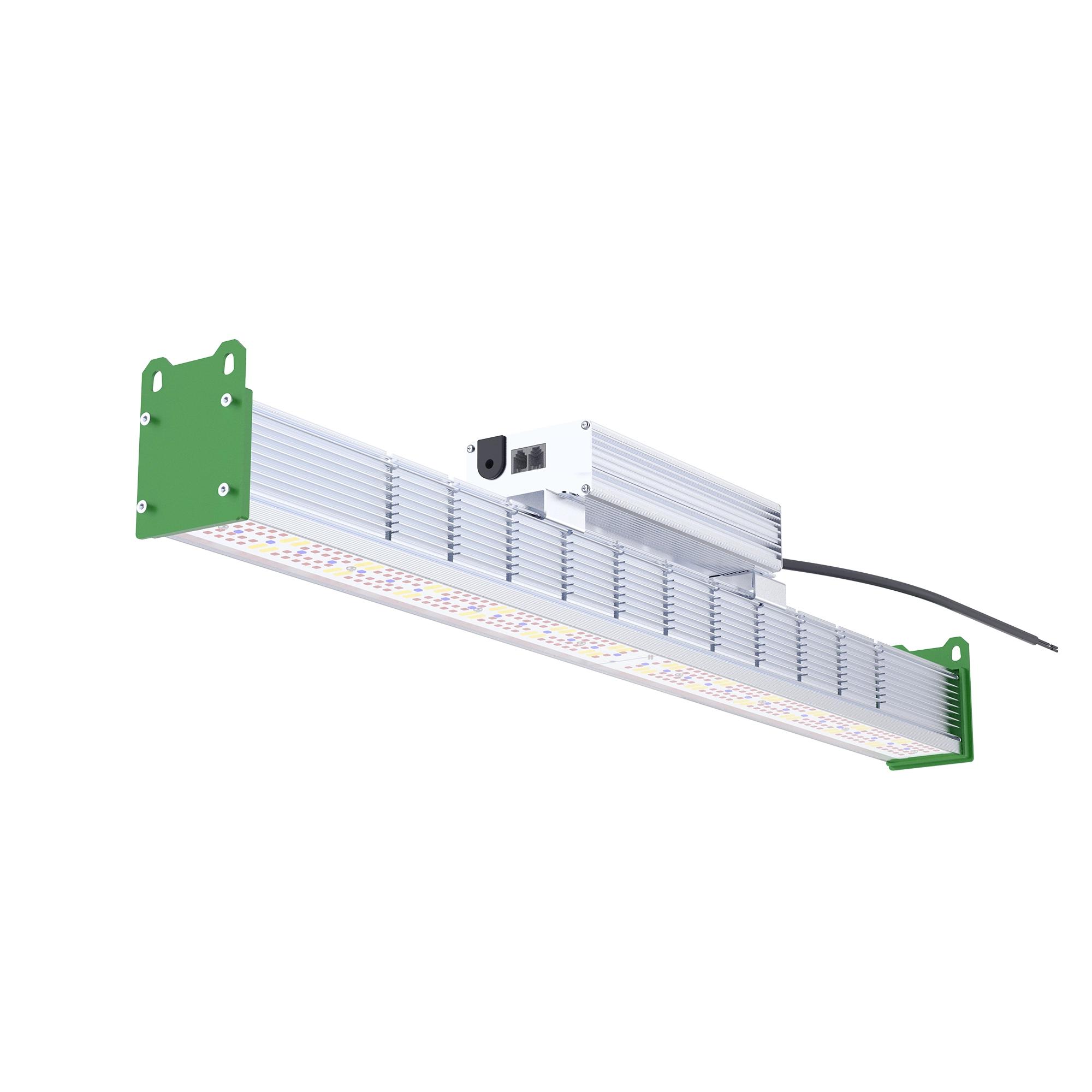
How to Specify Low-Profile Greenhouse LED Grow Bars
A practical checklist for specifying low-profile greenhouse LED grow bars using verified Number specs, DLI planning, controls, and sample approval.
A low-profile greenhouse LED grow bar is not a smaller toplight. It should be specified as a fixture for benches, low trusses, propagation zones, research bays, or narrow greenhouse sections where mounting height, shadowing, and service access are tighter than a conventional high-output toplight layout. The commercial question is: what must be verified before a buyer treats a compact bar as production equipment rather than an accessory?
Use DLI first, then fixture dimensions and controls. Virginia Tech Extension defines daily light integral as the total photosynthetic light received over 24 hours, and Purdue Extension explains that greenhouse DLI is affected by season, glazing, structure, shading, and photoperiod. Those sources support the planning method; they do not prove any crop result for a specific Number fixture.
Start with the lighting job
Define whether the bar is expected to add supplemental DLI, extend photoperiod, improve uniformity on benches, or light a limited-height production area. Those are different jobs. A long-day photoperiod task may need lower intensity over a longer schedule, while a production-DLI task needs a target PPFD map at canopy height and a clear daily operating window.
For a low-profile greenhouse zone, record five inputs before asking for a quotation: crop and growth stage, target DLI or PPFD range, bench or bay dimensions, available mounting height, and whether existing daylight varies enough to justify dimming zones. If the project cannot supply those inputs, a sample fixture can still be reviewed mechanically, but the lighting layout is not ready for a performance commitment.
Use verified Number specs as the short list
For higher-output compact greenhouse use, Sanity currently lists LEDtb F320-Led Greenhouse Toplight 320W with 1120 μmol/s PPF, 3.5 μmol/J efficacy, 0-10 V dimming, passive thermal management, -20°C to 35°C operating temperature, 3.0 kg weight, and a 3-year standard warranty. The same product record lists CE and RoHS certifications and describes IP65 waterproof construction, tempered glass, and customizable length, power, spectrum, and PPE for tailored projects.
For lower-output or narrower zones, Sanity currently lists LEDtb F75 indoor vertical farming LED light as a 75W/100W family with 188/250 μmol/s summary PPF. Its detailed specification row documents 75W±5% power consumption, 188 μmol/s PPF, 2.5 μmol/J efficacy, 0-10 V dimming, passive thermal management, -20°C to 35°C operating temperature, 3.3 kg weight, and a 3-year standard warranty. Because the detailed row only states the 75W figure, a buyer should request the final wattage-specific datasheet before approving a 100W configuration.
Decision Checklist
1. Confirm canopy geometry before wattage
Low-profile fixtures are often chosen because the structure cannot accept a large fixture, not because the crop needs less light. Ask for the mounting height, row spacing, bench width, and obstruction map before comparing wattage. A 320W bar may fit the output requirement but still be wrong if it creates service-access conflicts or sharp uniformity changes near posts, curtains, or hanging baskets.
2. Separate supplemental DLI from photoperiod lighting
If the goal is supplemental DLI, request a PPFD layout at the actual canopy height and calculate the resulting DLI from PPFD and operating hours. If the goal is photoperiod control, confirm that the lighting schedule and spectrum are appropriate for the crop program. Do not use the fixture PPF alone as a crop outcome claim.
3. Match controls to real zones
Both LEDtb F320 and the detailed F75 record list 0-10 V dimming. That makes zone planning important: group fixtures by crop stage, daylight exposure, mounting height, and operational schedule. Avoid putting a shaded propagation bench and a brighter perimeter bench on the same dimming channel unless the grower accepts different plant-level light conditions.
4. Treat IP and glass details as application checks
The F320 record describes IP65 waterproof construction and tempered glass; the F75 record describes IP65 waterproof construction and a 150° beam. These are useful selection points for humid greenhouse work, but they are not substitutes for a site review. Confirm washdown expectations, condensation risk, cleaning chemicals, cable routing, and whether glass or beam angle creates glare or maintenance constraints in the specific bay.
5. Require sample approval for custom versions
The F320 record lists customized length, power, spectrum, and PPE as acceptable for tailored projects. That is commercially useful only when the buyer freezes the configuration before production. For OEM or project supply, use a sample approval package that includes mechanical drawing, electrical input, dimming behavior, spectrum file, photometric file where available, label artwork, packaging, and the final datasheet. A project buyer can start that discussion from the Number products and project inquiry page.
What not to claim without more evidence
Do not promise yield improvement, energy savings, rebate eligibility, certification-directory listing, or crop quality changes from these records alone. The verified first-party data supports fixture selection and project scoping. It does not replace a crop trial, a site-specific PPFD map, utility documentation, or third-party certification lookup.
Best-fit recommendation
Choose the F320 direction when the greenhouse needs a compact bar with higher verified output, 0-10 V dimming, and a 320W class design for low-profile or tailored greenhouse sections. Consider the F75 direction when the project needs lower-output bars for benches, propagation, vertical-farm-style areas, or more distributed light points. In both cases, the next technical step is not a purchase order; it is a layout review with target DLI, canopy geometry, control zones, and final datasheet confirmation.