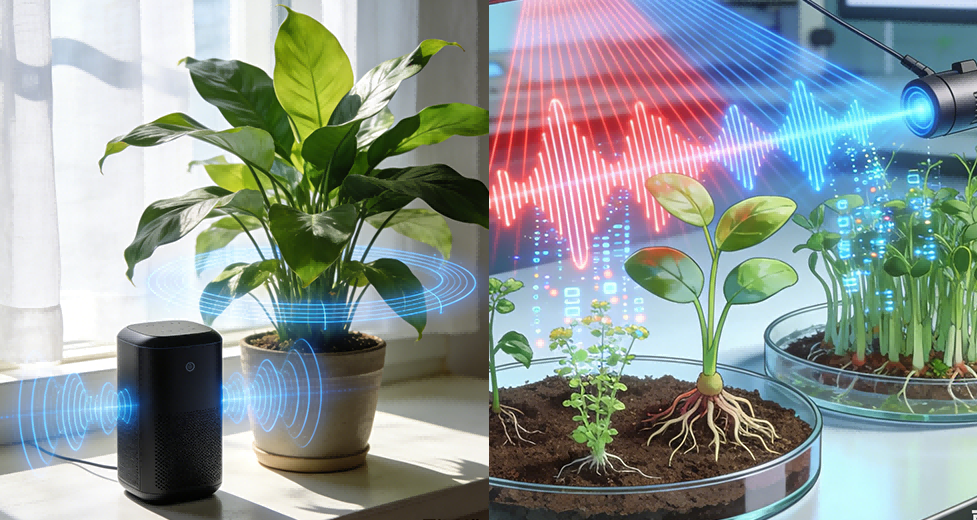
The Logic of Light: Engineering the Future of Photobiological Cultivation
In the evolving world of controlled environment agriculture (CEA), a persistent myth suggests that serenading plants with classical music can boost yields. While this provides a romantic narrative for hobbyists, the rigorous reality of commercial horticulture is far more profound: Plants are functionally deaf to melody, but they are biologically "hardwired" to decode the mathematical logic of light.
As a premier OEM/ODM manufacturer of high-performance LED systems, our mission is to move beyond "lighting" and enter the era of Spectral Programming.
I. The Acoustic Myth vs. The Mechanical Reality
To understand why light is the superior driver of ROI, we must first address the "hearing" myth. Science does not deny that plants respond to sound, but the nature of this perception is purely mechanical.
- Vibrational 应激 (Stress Response): Research shows that plants can "sense" low-frequency sound waves (around 100 Hz). However, this is not a cognitive appreciation of music; it is a mechanical stress response.
- Survival Strategy: Corn roots have been observed growing toward 220 Hz frequencies. This isn't because they "prefer" the tone, but because that frequency perfectly mimics the acoustic vibration of flowing underground water.
- The Commercial Takeaway: For a commercial facility, sound is a negligible variable. To drive profitability, investment must be focused on the primary driver of growth: Photosynthetic Photon Flux (PPF).
II. Light: The Biological "Operating System"
If sound is a clumsy, one-way shout, light is the "mother tongue" that plants execute with pinpoint precision. Plants have evolved a highly efficient optical decoding system using Phytochromes—precision sensors within the cells that function like a biological CPU.
- Environmental Intelligence: Phytochromes monitor the ratio of Red (R) to Far-Red (FR) light. If FR levels rise, the plant "calculates" that it is being shaded by a neighbor and triggers a "shade avoidance response," rapidly elongating its stem to reach for the sun.
- Hormonal Command: Red light (660nm) activates specific sensors that regulate the concentration of Abscisic Acid (ABA)—the "dormancy hormone." By controlling light, we effectively control the plant’s alarm clock, commanding it when to wake up, when to grow, and when to flower.
III. From "Illumination" to "Spectral Programming"
The evolution of our LED TB830 series represents the transition from simple illumination to advanced programming. By providing a "Light Recipe," we allow growers to manipulate the plant’s chemical composition:
- Deep Red (660nm): The high-octane fuel for photosynthesis. It directly drives biomass and increases the size of the harvest.
- Deep Blue (450nm): The "morphological sculptor." It ensures plants remain compact and strong while inducing the production of essential oils, terpenes, and anthocyanins—key for high-value crops.
- Far-Red (730nm): The "biological override." It can trigger the "Emerson Effect," boosting the efficiency of other wavelengths and shortening the overall flowering cycle, allowing for more harvests per year.
IV. The Next Frontier: Laser Precision and Narrow-Band Efficacy
The quest for the "Language of Light" is now moving toward Laser Agriculture. Recent R&D suggests that by using laser diodes, we can achieve spectral widths as narrow as 1.6nm—perfectly aligned with chlorophyll absorption peaks.
- Zero Waste: Unlike standard LEDs that have a broader spectral spread, laser technology eliminates "filler" light that plants cannot use.
- 20% Efficiency Gain: Early data shows that laser-based systems can increase net photosynthetic rates by nearly 20% compared to traditional high-end LEDs. As an OEM partner, we are already integrating these insights into our next generation of "Smart-Spectrum" fixtures.
V. Why Technical Engineering Trumps Romantic Sentiment
In a professional plant factory, the silent flickers of red and blue light represent a second-by-second technical conversation with the crop.
- Our Engineering Standard: We deliver fixtures with efficacy up to 3.5 $\mu mol/J$, ensuring that almost every electron is converted into usable light for the plant.
- Industrial Compatibility: Our systems support 120-480V global power grids and 0-10V/PWM dimming, allowing for seamless integration into the world's most sophisticated cultivation systems.
Conclusion
Serenading a succulent is a gesture of human tenderness; programming a crop with light is a rational tribute to the laws of nature. A beam of precisely calculated light is the most effective "love letter" a grower can send to their crop—and the most profitable one for their business.