How to Verify R135 Under-Canopy Daisy-Chain Limits
Use the published R135 voltage-specific chain limits, then close the electrical and installation evidence gaps before approval.
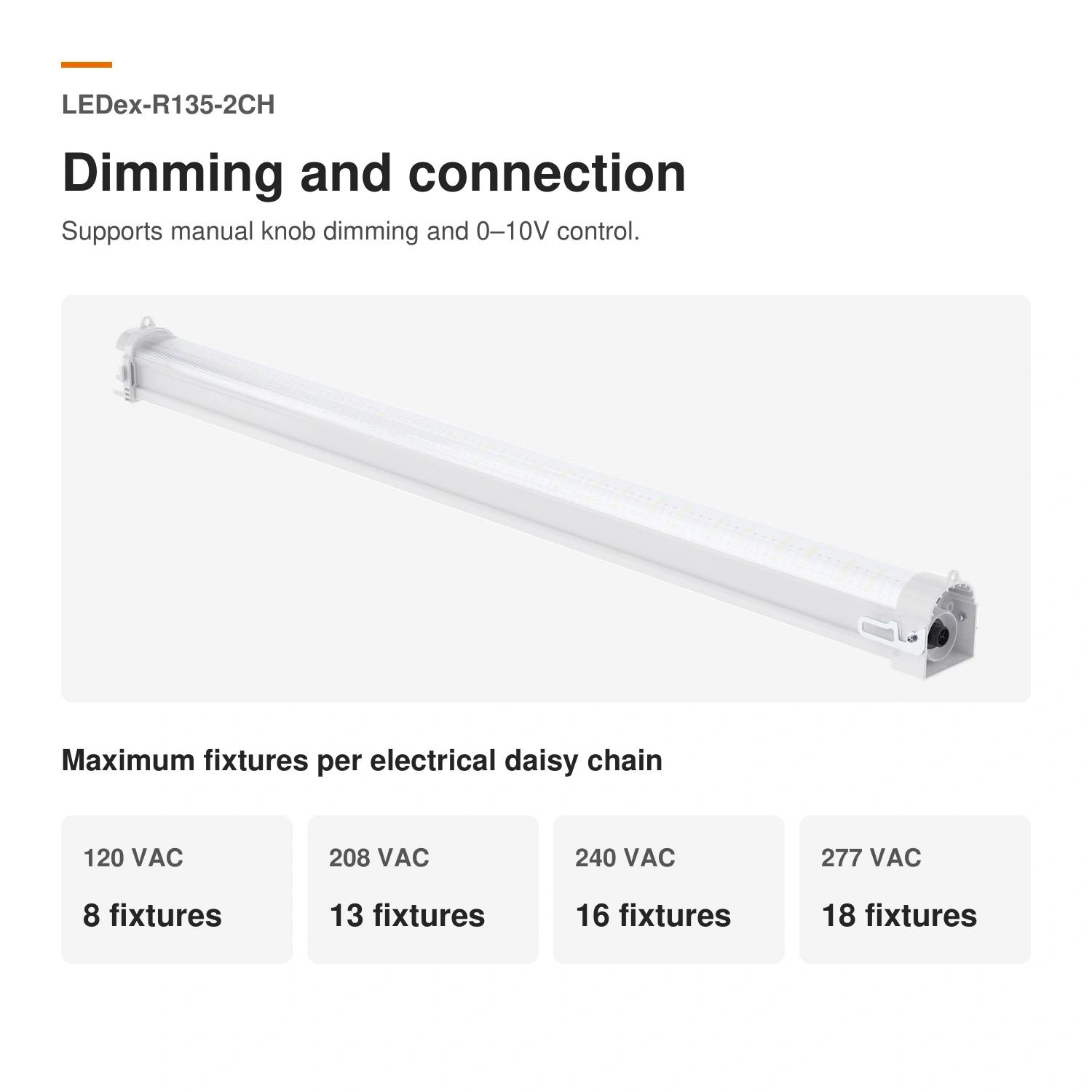
Before approving an under-canopy run, identify the exact fixture and supply voltage, then use the model-specific electrical daisy-chain limit rather than a generic fixture count. For the current Number LEDex-R135-2CH record, the maximum electrical daisy-chain length is 8 fixtures at 120 VAC, 13 at 208 VAC, 16 at 240 VAC, and 18 at 277 VAC. These are published maximum chain counts for this product record, not a branch-circuit design, a connector-compatibility statement, or a recommendation for a particular installation.
Start with the approved product row
Record the model as LEDex-R135-2CH and the product code as 80.02.0763 on the order and layout review. The current product record lists nominal power as 135 W, split into a 120 W main channel and a 15 W far-red channel, and input voltage as 120–277 V AC. Keep the approved fixture identity, supply voltage and daisy-chain row together; changing any of these inputs requires the supplier and installer to review the planned connection again.
Match the chain count to the confirmed supply voltage
Use only the row that matches the voltage actually planned for that run: 8 fixtures at 120 VAC; 13 at 208 VAC; 16 at 240 VAC; or 18 at 277 VAC. Do not average the rows, apply a higher-voltage count to a lower-voltage supply, or treat the maximum as a substitute for project electrical review. If the site voltage, fixture revision or connection arrangement is not confirmed, leave the chain count open rather than selecting a number from a different condition.
Close the installation evidence that the product row does not provide
The current published R135 record does not state the branch-circuit rating, overcurrent protection, cable or connector ratings, pinout, permitted cord length, installation topology, local-code treatment, or a project-specific loading calculation. Obtain those items from the responsible supplier, electrical designer and installer for the exact ordered configuration. The record does list knob and 0–10 V dimming, but it does not establish a specific controller-to-fixture pairing or control wiring arrangement.
Keep a release sheet with the fixture model and revision, supply voltage, selected maximum-chain row, planned fixture count per run, current product record date, approved power and daisy-cord part numbers, layout reference, and the named owner for each unresolved electrical item. This turns a catalog limit into a traceable approval check without presenting it as a site design or safety sign-off.
Keep rack planning and electrical limits separate
A chain-count row does not establish fixture spacing, canopy light level, rack clearance, mounting capacity or crop performance. Treat the electrical approval sheet and the physical layout as separate records. For a separate rack grow-bar connection checklist, use the linked guide only for its own stated models and conditions.
Read the vertical-farm grow-bar daisy-chain guide for its model-specific planning checklist.