How to Specify Daisy-Chained LED Grow Bars for Vertical Farm Racks
Specify daisy-chained LED grow bars for vertical farm racks using DLI, PPFD, circuit limits, dimming, IP rating, and verified Number specs.
To specify daisy-chained LED grow bars for a vertical farm rack, start with the crop light target and shelf geometry, then verify fixture PPF, PPFD uniformity, branch-circuit load, daisy-chain limits, dimming method, IP rating, operating temperature, and service access. Wattage alone is not enough because it does not describe photons at the canopy or the electrical limits of a connected run.
Evidence scope: Number model claims in this article come from current Sanity product records retrieved on 2026-07-23. DLI and PPFD terminology follows the Virginia Cooperative Extension DLI guide, and controllability context follows DesignLights Consortium horticultural technical requirements. This article does not use unverified yield, savings, certification-directory, or customer-result claims.
1. Collect the rack inputs before choosing a bar
- Target crop stage, target DLI, photoperiod, shelf length, shelf width, plant-to-fixture distance, and expected canopy height.
- A measured or modeled PPFD map for every shelf, not only the center point under one fixture.
- Supply voltage, branch-circuit capacity, planned fixture count per run, connector current limit, cable length, and the electrician or authority having jurisdiction for the site.
- Humidity, cleaning method, ambient temperature near the driver, airflow around the bar, and access space for replacement.
- Control-zone plan: which shelves dim together, which crop stages need separate schedules, and whether the grow room will use simple 0-10 V dimming or a higher-level controller.
2. Convert the light target into a fixture plan
Use DLI to set the daily photon target and PPFD to check the instantaneous shelf-level result. For electric lighting, the working relationship is: DLI equals average PPFD multiplied by operating hours multiplied by 3,600, then divided by 1,000,000. For example, a 12 mol/m2/day target over a 16-hour photoperiod requires about 208 micromol/m2/s average PPFD at the canopy. That example is a planning calculation, not a crop recommendation.
After the target PPFD is known, request a shelf-specific layout. The useful deliverable is a PPFD map with minimum, average, maximum, mounting height, fixture spacing, and reflectance assumptions. A product PPF value describes total fixture output; it does not prove the rack will be uniform.
3. Match the bar to the shelf and crop stage
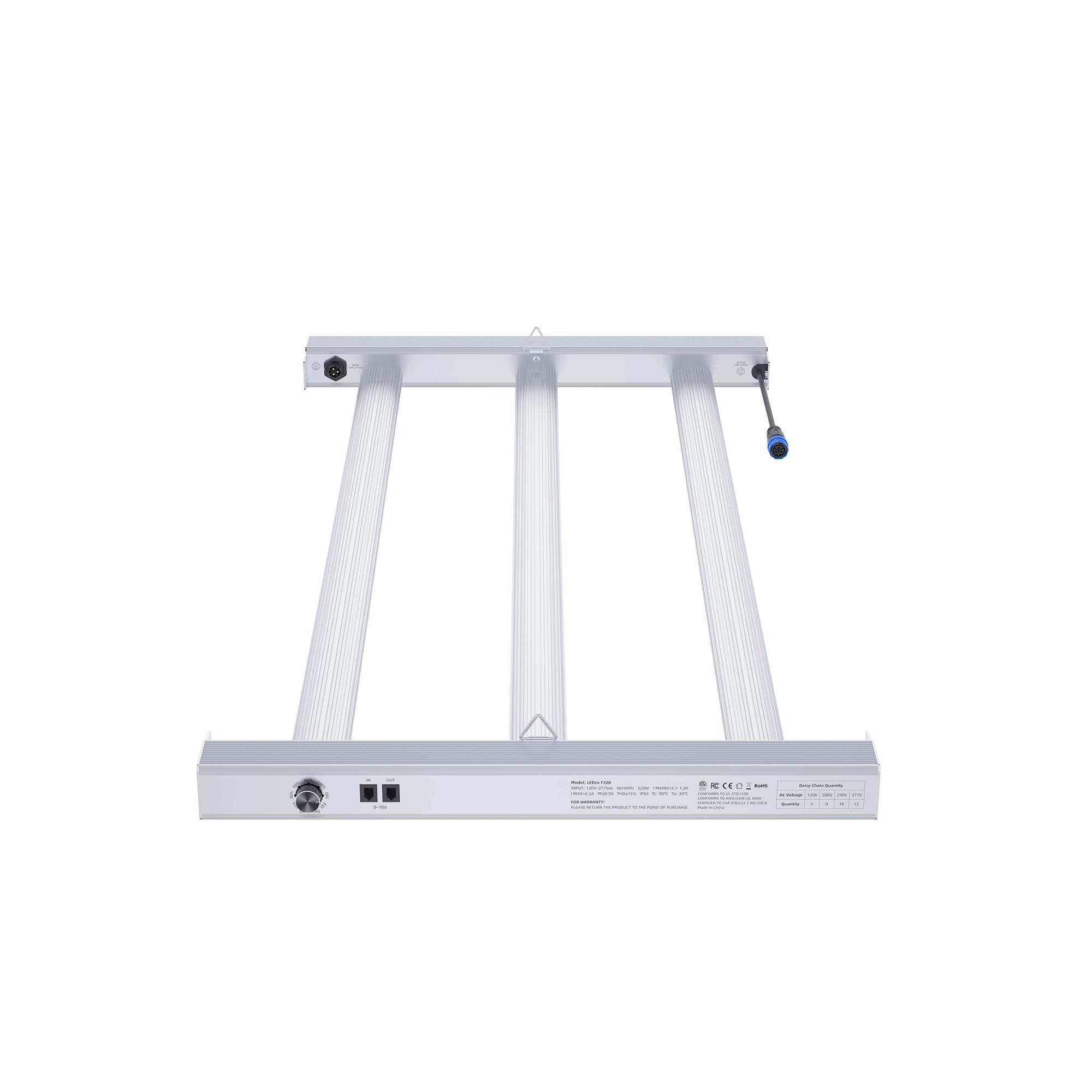
LEDzx F320 is recorded at 320 W +/-5%, 800-930 micromol/s PPF, 2.5-2.90 micromol/J efficacy, passive thermal management, 0-10 V dimming, and an operating temperature range of -20 C to 35 C. Sanity also records it as designed for indoor grow rooms and vertical shelves, with the ability to daisy-chain multiple bars together. For production shelves that need higher photon output per fixture, treat F320 as a candidate only after the layout confirms PPFD uniformity and the electrical run length is approved.
LED PGF18 is recorded at 18 W +/-5%, 40 micromol/s PPF, 2.2 micromol/J efficacy, 0-10 V dimming, aluminum passive cooling, and an operating temperature range of -20 C to 35 C. Its feature data states daisy-chaining multiple bars with one main plug up to 25 units and use on indoor multi-layer shelves. That makes it a candidate for nursery or low-intensity rack zones where many short bars may be easier to service than fewer high-output bars.
LEDtb F75 is recorded at 75 W +/-5%, 188 micromol/s PPF, 2.5 micromol/J efficacy, 0-10 V dimming, and 150-degree beam data. It also lists customizable power and dimension ranges in the product record. Use it when the buying question is custom bar length or spectrum; ask Number to confirm the final SKU before quoting because the live spec table currently lists the 75 W version.
4. Treat daisy-chain planning as an electrical design task
A daisy-chain feature is not the same thing as an approved branch-circuit design. Before purchase, calculate maximum connected wattage using the rated power plus tolerance, confirm the allowable fixture count per run from the datasheet or engineering review, and keep the final branch-circuit design with the electrical professional responsible for the facility.
For the PGF18, the current product record gives a concrete chain limit of up to 25 units. For the F320, the product record verifies daisy-chain capability but does not provide a maximum unit count in the fields checked for this article, so the smallest evidence item needed before purchase is the project-specific wiring diagram or datasheet page confirming maximum connected units, voltage, connector current, and cable length.
5. Keep controls and serviceability in the spec
All three fixture families discussed here list 0-10 V dimming in the current product records. Use the project control-zone checklist to decide which shelves share one signal and which need separate schedules. In a multi-layer farm, control zones usually follow crop stage, cultivar, target DLI, aisle orientation, and sensor placement rather than the easiest cable path.
Service access matters because rack lights are dense. Leave room to unplug, clean, inspect connectors, replace bars, and read labels without disturbing plants. If the farm uses misting, frequent washdown, or high humidity, keep IP rating and connector protection in the approval packet instead of treating them as generic LED features.
Purchase-ready checklist
- Rack drawing with shelf count, shelf dimensions, plant-to-fixture distance, and mounting details.
- Target DLI, photoperiod, requested average PPFD, and accepted minimum-to-average uniformity range.
- Fixture model, power tolerance, PPF, efficacy, dimming method, IP rating, operating temperature, warranty term, and product image/spec revision date.
- Daisy-chain maximum units per run, cable length, connector rating, supply voltage, branch-circuit plan, and local-code review owner.
- Sample approval plan: confirm one shelf or bay before scaling to the full rack room.
Next action
Send Number the rack drawing, target crop stage, target DLI or PPFD, photoperiod, supply voltage, and desired controller type. The useful response should be a model recommendation, PPFD layout, daisy-chain wiring limit, and sample approval plan.